
The main aim of evaluating a player’s performance in a tennis match is to enhance performance under pressure and reduce the risk of injury. A player’s performance can be evaluated in two ways: a) qualitative analysis, b) quantitative analysis.
Qualitative analysis is a subjective process in which a coach assesses a player’s performance based on observation of strokes, footwork, tactics, and other elements of the match. Quantitative analysis is more objective, as it is based on measurements. Biomechanical variables related to a particular stroke can be measured using various devices such as a radar gun or through video analysis software after recording the player during the match or practice.
Four Main Tasks of Qualitative Analysis
The process of qualitative analysis consists of four tasks that cycle continuously, supporting long-term improvement.
1. Preparation: The first task involves acquiring more knowledge about a specific stroke or element of performance that the coach wishes to analyse. The coach gains this knowledge through conferences, books, videos, and long-term study of the subject.
2. Systematic observation: The stroke in question should be observed from different angles and in various situations to best assess its quality, especially when played under pressure. One of the best ways to achieve this is through video recording, as technology allows us to see what the human eye cannot. Human vision can capture only about 4–5 frames per second (FPS), while a mobile phone camera captures from 30 to 69 FPS. Most modern cameras now allow high-speed footage with 120 FPS or more, which, when combined with a high shutter speed (1/500 or 1/1000), provides the coach with extremely clear footage of the player’s strokes and movements. The only disadvantage of video recording is that the resulting image is displayed in two dimensions. Therefore, it is important to record the player from multiple angles to gain a better view and understanding of the stroke in a real 3D environment.
3. Evaluation of performance: The coach needs to determine the strengths and weaknesses of the stroke and diagnose the cause of any poor performance. The main question for the coach at this stage is to identify the primary causes of the stroke’s weakness. These can originate from:
- Incorrect stroke mechanics (technique)
- Mental weakness, where the stroke functions well in practice but not in matches
- Lack of strength in certain parts of the body
- A stylistic variation of a stroke that still causes some degree of poor performance
4. Intervention: Once the coach has determined the causes of poor performance, interventions should be prioritised and the coach should begin helping the player correct the flaws. The coach can intervene through verbal feedback, manual or kinaesthetic guidance, video demonstration, visualisation, and other methods.
Three Ways of Quantitative Analysis
To obtain objective data about a tennis player’s performance, it must be measured, which is the role of quantitative analysis. The three main ways of measuring and recording data about a player’s performance are:
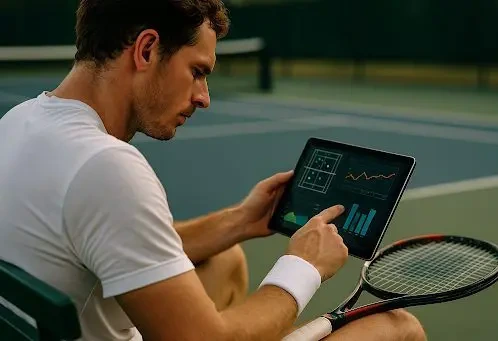
1. Match play statistics: Tools for match play notation and statistics are now very affordable or even free, with smartphone and tablet apps allowing the coach to quickly and easily note particular elements of a player’s performance and obtain detailed statistical data that the app calculates during or after the match.
2. Notational analysis of player movement or tactical play: Most smartphone apps for tennis notation and analysis can provide the coach with tactical feedback based on the data entered. Recording the player’s movement is much more challenging and requires more sophisticated and expensive equipment, such as Hawk Eye, which not only tracks the ball and its trajectory but also tracks the player’s movement.
3. Documentation of complex biomechanical variables: Some of these can be measured with advanced video analysis software such as Dartfish.com or SiliconCoach.com. For others, the coach would need to use motion capture systems like Vicon.com, which can provide a 3D graphical image of the player’s movements.
The most practical applications of quantitative analysis arise when the player experiences pain in a particular body part or when the coach determines that the player lacks certain physical qualities that can be directly measured. The most common injuries occur in the wrist, shoulder, lower back, and knee. With detailed quantitative analysis, the causes of these injuries can be identified and addressed. The force platform, on the other hand, assesses the explosiveness of the player in terms of leg drive during the serve or the first step towards the ball after the split step.
Player Analysis Technology (PAT) Approved by ITF
The International Tennis Federation (ITF) announced a rule change in 2014 allowing the use of “smart” equipment during competition and permitting access to information generated by that equipment at times when coaching is allowed. This smart equipment is collectively known as Player Analysis Technology (PAT) and falls into three categories:
1. Integrated equipment: This includes equipment carried or worn by the player, such as wearables (Google Glass), tennis-specific equipment (rackets), and non-tennis-specific equipment (heart rate monitors, activity trackers).
2. Remote equipment: These are devices not carried or worn by the player, such as camera-based tracking systems.
3. Auxiliary equipment: This refers to equipment that does not record the player’s performance but may perform other PAT functions.
To record various data (such as force, movement, and physiological information) from the player, their strokes, and movements, PAT devices typically use sensors such as accelerometers, gyroscopes, cameras, and electrodes. The first rule change states that PAT devices are permitted during competition, but only if the PAT has been approved by the ITF prior to the match. The second rule defines PAT devices in detail and restricts their use during matches so that data can only be accessed after the match or during the match if coaching is permitted.
In summary, all PAT devices developed so far have focused solely on providing coaches with data to help them assess a player’s technique and tactics. However, as we all know, the mental game is the key difference at higher levels of tennis. Imagine being able to measure a player’s mental state with a PAT device.
How would that help you improve his performance in matches?