
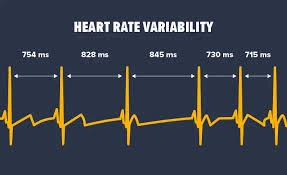
When exercising or training, most people monitor their heart rate, calorie burn, BPM, and other variables. However, one metric that has become very popular in recent years is Heart Rate Variability (HRV). Once you understand what it means, you will see how it can benefit your fitness and sports training.
What is HRV?
Heart Rate Variability is, simply put, the amount of time between your heartbeats.
The average human BPM (beats per minute) is typically between 60 and 100. This means your heart beats at least 60 to 100 times per minute. However, did you know that your heart rate increases when you inhale and decreases when you exhale? This is because, on inhalation, your heart must saturate your blood with the oxygen you have just inhaled so it can be distributed throughout your body. When you exhale, there is no new oxygen, so your heart does not need to work as hard. It is an involuntary reaction that most of us take for granted.
Heart Rate Variability measures this acceleration and deceleration of your heart rate. A high HRV indicates greater resilience and lower stress levels. A lower HRV suggests you are experiencing more stress and are less resilient. Essentially, HRV is a way to measure how much stress you have in your life.
How is HRV Measured?
There are several ways to measure your Heart Rate Variability. Most sports organisations use the Omegawave, a £30,000 machine that measures your heartbeat. Of course, very few people have the resources to purchase such equipment. A deep breathing test (DBT) is a quick and simple way to measure your HRV. For this, you perform deep breathing techniques for 60 seconds, after which your nervous system (both sympathetic and parasympathetic) is monitored for activity. This is just a simple way to detect your HRV, and there are many more complex scientific methods of testing, such as:
- Time domain analysis – These tests measure the time between heartbeats, using various mathematical formulas to determine the standard deviations of your heartbeat. The standard deviations indicate how fast your heart beats when you inhale and how slow it beats when you exhale.
- Geometric methods – For those who prefer visualisation, the results of the time domain analysis can be translated into geometric patterns, allowing you to see a graph of your HRV.
- Frequency domain methods – This test uses electrical frequencies to measure your HRV.
All of these tests last at least 5 minutes. At least 60 seconds are required to measure the highest frequency part of the HRV, and 4 minutes are needed to measure the lowest frequency part. Some tests may last several hours – up to 18 hours connected to an ECG machine.
How You Can Measure HRV
If you do not have the time or money for a clinical test, you can test your own HRV using one of the many smartphone apps available online:
- iThlete – This app allows you to track your HRV in addition to your heart rate and calorie burn. You will need an ECG receiver and a heart rate chest strap, but it makes it easy to measure your HRV directly from your smartphone.
- Bioforce – The Bioforce HRV app is available for both Android and iOS devices and measures your heart rate similarly to iThlete. It takes longer to measure your HRV, but the increased duration helps you obtain more accurate results.
In addition to these apps, the Polar RS800 can also measure your HRV as well as your heart rate. This Polar heart rate monitor watch has been used in scientific research into HRV, so it can be useful for checking your Heart Rate Variability. You will need to manually export the data to your computer, but it will provide the raw data you need to measure your HRV.
HRV and Wellness
How does knowing your HRV help you?
- It can help you determine if you are training too hard. Overtraining can lead to stress and reduced physical performance.
- It can help you assess your rate of recovery (how much time you need to rest between training sessions).
- It can help you decide when to train hard and when to take it easy.
- It can help you identify if you are stressed, if your blood pressure is too high, or if there are other physiological signs of strain.
If you are an athlete, monitoring your HRV will help you make optimal progress without pushing your body beyond its limits.
HRV in Tennis
When training to become the best tennis player you can be, you will spend much of your time on cardiovascular conditioning drills. If you push yourself too hard, you may reach a plateau in your workouts. If you do not push yourself hard enough, you will not make progress, become faster, or reach your peak conditioning.
Monitoring your HRV will reveal the stress caused by exercise and indicate when to reduce your training intensity. You will notice signs of strain on your body, know when it is time to take a break, and recognise when you can push yourself to achieve your fitness goals.
HRV is purely a physiological measurement, and currently we use it only to assess the physical state of the players. However, we also know that our mental and emotional states affect our physiology and can therefore be indirectly measured.
An interesting question arises: is there a correlation between HRV and the Ideal Performance State (IPS) of the player, and can we therefore track the mental state of our player throughout the match by monitoring HRV?
Imagine having a chart tracking your player’s HRV, the fluctuations in the score, and your notes on their behaviour at key points. How could that data help you diagnose your player’s mental state during each point of the match and assist you in developing a specific mental training programme for your player?