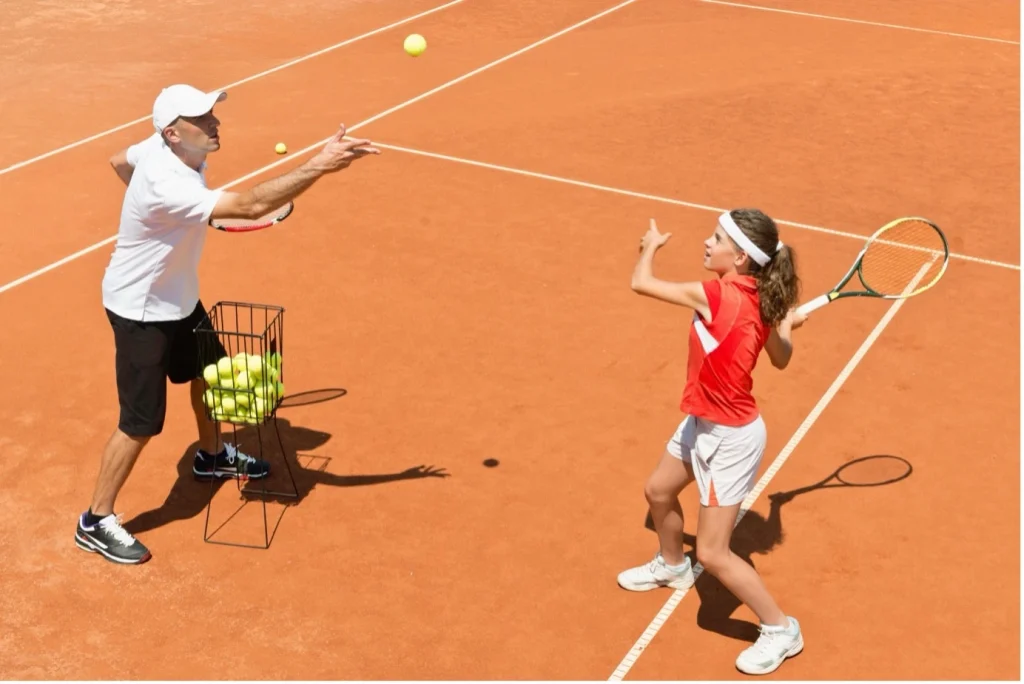
From the outside, the difference between practice and competition may seem obvious: more pressure, more emotion, more at stake. But what actually changes inside the game when a player moves from training court to match court? Training is where tennis players build skills. Matches are where those skills are tested.
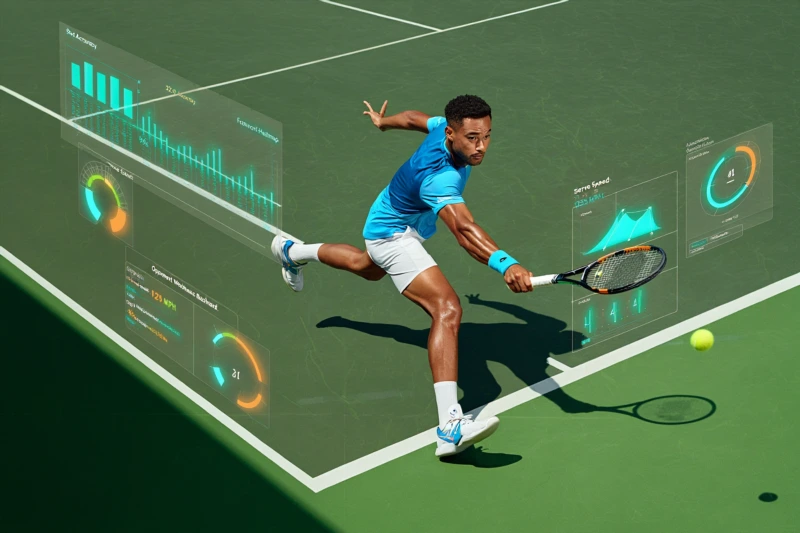
Using data collected with Matchbeep, we can look beyond perception and analyse how performance truly differs between practice and match play. This blog focuses on one professional tennis player only, and compares her match and practice data to better understand how her game adapts under competitive conditions.
The first and most important finding from female tennis player’s data is volume and structure. Practice sessions occur frequently and are often short, segmented, and task-oriented. Matches, by contrast, are rare but dense. They compress physical effort, tactical decisions, and emotional regulation into a continuous performance lasting around 90 minutes. From a data perspective, matches represent a high-density stress test of the player’s game.
This difference alone shapes performance:
- Practice allows pauses, resets, and corrections
- Matches demand continuity and decision-making without interruption
- Fatigue in practice is optional; in matches it is unavoidable
Observed female tennis player’s ability to maintain rally stability in matches indicates that her training prepares her well technically – but the context of those rallies changes everything.
Shot Volume and Rally Structure
When we compare shot data, the contrast becomes clearer. In practice, tennis players often accumulates shots across multiple short drills. Rally lengths tend to be longer, and the environment is more predictable. In matches, however, shot volume is concentrated on a single continuous session, with rallies averaging around six shots.
| Variable | Match | Practice |
| Shots per session | 388 | 516 |
| Shots per hour | 316 | 482 |
| Shots per rally | 5.7 | 7.9 |
What this tells us:
- Match rallies are shorter, but more intense
- Each rally carries tactical consequence
- Errors and successes directly affect momentum
Shot Distribution: Same Tools, Different Use
Interestingly, forehand and backhand distribution remains relatively balanced in both practice and match. The tools do not change. What changes is how they are used.
| Shot type | Match | Practice |
| Serve | 23 % | 19 % |
| Forehand | 39 % | 41 % |
| Backhand | 27 % | 29 % |
| Other shots | 11 % | 11 % |
In practice:
- Shots are often repeated in predictable patterns
- Tactical intention is predefined
In matches:
- Shot selection responds to the opponent
- Backhand involvement increases under pressure
- Patterns evolve within the match
This highlights an important distinction: practice builds the toolbox, but matches decide when and why each tool is used.
Tempo: Similar Capacity, Different Control
One of the most interesting comparisons emerges in tempo. In practice, tennis player frequently reaches equal or even higher stroke tempos than in matches. This confirms that her physical and technical capacity is not limited. She can play fast, repeat strokes, and sustain rhythm in training environments. In matches, however, tempo becomes more controlled. The overall rhythm slows slightly, while acceleration becomes more selective.
| Variable | Match | Practice |
| Serve & return tempo | 28.3 spm | 31.6 spm |
| Forehand tempo | 23.4 spm | 26.8 spm |
| Backhand tempo | 23.3 spm | 27.1 spm |
What this tells us:
- Practice expresses capacity
- Matches require regulation
Rather than a drop in ability, the data shows a shift in priorities. In competition, female tennis player manages tempo to preserve accuracy, decision quality, and energy across the match.
Stroke Speed and Power: From Expression to Efficiency
A similar pattern appears when comparing stroke speed and power. This suggests a clear behavioural adjustment. When the score matters, tennis player relies less on maximum output and more on efficient, sustainable execution. This is a key marker of competitive maturity. The data shows that she does not simply “play the same, but under pressure”, she adapts.
| Stroke | Match | Practice |
| Serve | 118 km/h | 122 km/h |
| Forehand | 104 km/h | 108 km/h |
| Backhand | 97 km/h | 101 km/h |
In practice:
- Peak values are higher
- Variation is greater
- Risk-taking is more frequent
In matches:
- Stroke outputs are more stable
- Extreme values occur less often
- Execution becomes more repeatable
Physiological Load: The Invisible Difference
Heart rate data clearly separates match play from training. In practice, intensity rises and falls with drills. Recovery is built into the session structure. In matches, heart rate increases progressively and remains elevated across longer periods.
What this means:
- Matches impose cumulative physical and mental stress
- Later stages of matches demand efficiency, not force
- Decision-making occurs under growing fatigue
Tennis player’s ability to maintain stroke stability under these conditions indicates a solid physical base and good energy management, but also highlights where match-specific conditioning matters most.
The Transfer Question: Why Good Training Is Not Enough
Perhaps the most important conclusion from comparing match and practice data is this:
The gap between practice and match is not about skill, it is about context.
Observed female professional tennis player demonstrates strong technical and physical capacities in training. Matches challenge her ability to:
- Sustain those capacities without interruption
- Make decisions under fatigue
- Regulate emotion and rhythm when outcomes matter
This is not a weakness. It is the reality of elite sport. Data does not suggest that she needs more training, but rather more training that resembles match reality in density, continuity, and consequence.
What the Comparison Ultimately Reveals
Taken together, tennis player’s match vs practice comparison shows a player who:
- Possesses high technical and physical capacity in training
- Adapts intelligently in matches by reducing extremes
- Prioritises control, rhythm, and repeatability under pressure
- Uses competition to regulate, not exaggerate, her game
This is a profile associated with sustainable performance and long-term development.
Matchbeep Insight: Turning Comparison into Clarity
The value of comparing match and practice data lies in clarity, not judgement. By seeing where performance stays the same and where it changes, players and coaches gain a more accurate understanding of what competition truly demands. For Veronika Erjavec, the data confirms that her game translates well from training to match, while also clearly identifying where match-specific demands shape performance.
This is exactly where data is most powerful: not in measuring effort, but in guiding smarter preparation.