Notation (performance analysis, match charting, etc.) of a tennis match is crucial for analysing a player’s strengths and weaknesses, which include all four main areas of tennis: tactical, technical, mental, and physical. It is also vital for the coach, who needs to structure future training sessions based on the player’s strengths and weaknesses shown in the current match.
Noting key points about a player’s performance only by watching the match and trying to remember them will not produce a quality assessment or objective feedback for the player.
Firstly, there is a massive amount of data that can be gathered in a tennis match, which cannot possibly be remembered. Here are just a few examples of what a tennis coach may look for when assessing a player’s performance:
- Technique: player’s stroke production and movement (biomechanical principles: balance, rhythm, timing, etc.)
- Tactics: consistency of second serves, offensive forehands on short balls, defensive slice, low forehand volleys, dealing with high balls, taking control of the centre of the court, neutralising first serves, taking advantage of the opponent’s weaker backhand, etc.
- Mental: executing agreed rituals on serve and return, controlling activation on big points, handling mistakes, maintaining focus for longer periods
- Physical: quickness in adjusting to challenging balls, speed endurance in shorter but intense rallies, overall endurance throughout the match, explosive power on the serve, etc.
Secondly, our notation and analysis will always be subjective because our beliefs, emotional states, and attitudes cloud our judgement. Objective and detailed tennis match notation is essential for gathering relevant information about our player’s performance, as well as collecting key data on the current opponent that may be used in future matches to develop a winning strategy against him or her.
Match Notation in the Past
Before the era of computers, tablets, and smartphones, coaches often resorted to match notation on paper. We scribbled notes in various ways, trying to capture as much key information about the match as possible during the brief intervals between points or games, when we could finally record our observations from the previous points. Our notations were very simple and often quite messy, as we carried around sheets of paper or worn-out binders.
There were not many good systems known or available before the explosion of the internet, and they were hard to find, as only a few tennis books at that time included the author’s suggestions on how to accurately assess and analyse tennis matches. A simple match notation included marking first serves as in or out, and recording winners and unforced errors. While this method of noting a tennis match was quick, it lacked the depth of information needed for detailed match analysis and training session planning.
If a coach wanted to note down more information, he would barely be able to follow the match and observe his player’s behaviours and tactical decisions, as most of his time would be spent recording notes from the previous point.
Advantages of Detailed Match Notation
The more data we gather from a tennis match, the more relevant information we can extract. TV broadcasts of tennis matches almost always show match statistics at the end of each set and at the end of each match, and these stats typically include:
- First serve percentage
- Winners
- Unforced errors
- Break point conversions
- Total points won
- And others
By comparing the statistics of both players, we can quickly see the main differences in each category and why one player eventually prevailed over the other. To obtain this common statistical analysis of the match, a fair amount of data must be gathered, such as noting the outcome of every first serve, every break point, and how each point ended – where only winners and unforced errors are noted, but not forced errors, which actually play a key role in the modern tennis game.
The above analysis does not, for example, show to which side a player may have served better, or even to which corner he serves better or worse. It does not show whether break point conversions were achieved through aggressive play by the returner, or whether the server made a double fault or hit an unforced error. It does not include which strokes the player used to hit his winners, or with which shots he committed unforced errors. It also does not show at what score situations the player committed unforced errors. If he had many unforced errors on game points and break points, that can indicate mental weaknesses rather than technical or tactical ones. With more detailed match notation and smart analysis of the data, the player and coach could gain much more useful information.
How Notation and Match Analysis Improve Training Planning
Once the coach extracts relevant data from the notation, he can better assess his player’s strengths and weaknesses and plan training sessions accordingly. Here are a few quick examples of how a coach could plan training sessions with the player based on the notation and its analysis:
- High number of unforced errors on game points: add pressure with different scoring systems to the usual consistency drills.
- Low percentage of first serves: work on adding slight spin to first serves and increasing net clearance.
- Low conversion of break points: focus on diligently following return rituals and having a clear game plan for those points.
- Majority of winners played with the forehand: reinforce aggressive forehand drills to maintain the effectiveness of this weapon, and add more attacking drills for the backhand.
- Low percentage of points won on the second serve: have the player return more aggressively inside the court and set key targets to aim for.
How Notation Helps with Player-Specific Development
Thorough match notation provides very accurate information on the player’s specific strengths and weaknesses, and helps pinpoint key deficiencies that may turn the match around. Since each player, over time, develops their preferred game style, the coach’s role is to maximise the player’s strengths and minimise the player’s weaknesses. While an all-court player like Roger Federer benefited greatly in 2014 from having a net game expert such as Stefan Edberg as his coach, a counterpuncher like Andy Murray also gained significantly from Ivan Lendl’s coaching, as he won both his Grand Slam titles during that period.
Both players were well aware of their strengths and, while they worked to minimise their weaknesses, they continued to improve their strengths. A positive statistic in net points, combined with a less convincing statistic from the baseline, helps an all-court player decide more easily to keep approaching the net at the right opportunities. For a different type of player, having a very low number of unforced errors might have been key to performing well at lower levels, but it can also indicate a lack of aggression and a reluctance to take risks on crucial points in the match. The higher the level of players you deal with, the smaller the differences become, and the more detailed the notation must be to identify them.
Modern Smartphone and Tablet Apps For Match Notation
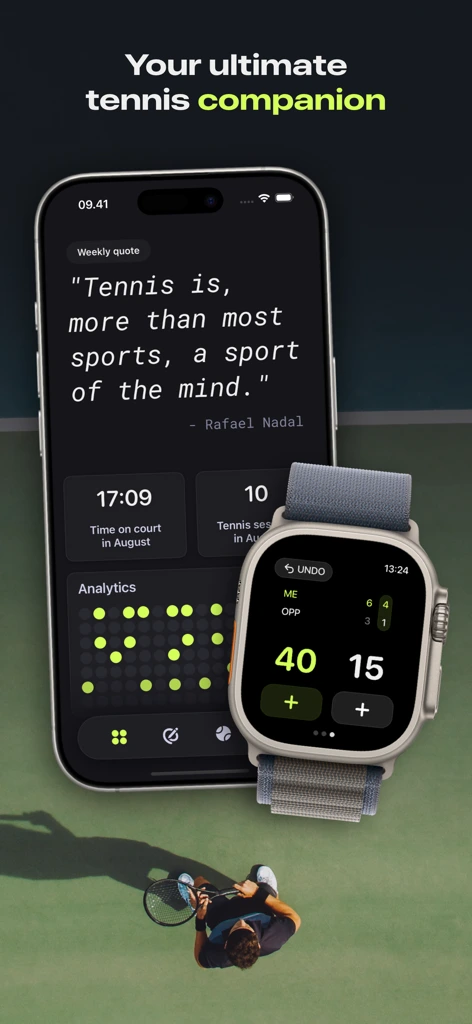
The affordability and widespread use of smartphones and tablets have enabled easy access to high processing power and more effective, detailed data input during matches. This has led to the development of numerous smartphone apps that help coaches collect significantly more data during matches and extract much more useful information from it. Previously, tennis match scoring apps such as TennisMath, Tennis Stats Pro, Pro Trecker Tennis, Tennis Stats, Stat My Tennis Pro, Tennis Score Tracker, and Tennis Trakker Pro dominated the market, but they did not meet users’ expectations, particularly those of tennis coaches.
Currently, technology development in the market is moving in two directions: towards the analysis of video clips, as seen with Swing Vision, and towards the use of wearable technologies that allow monitoring of tennis players’ physiological parameters. However, there is still no technology available that, in addition to physiological indicators, can monitor specific tennis performance indicators such as the type, speed, power, and tempo of tennis shots. Perhaps Matchbeep will fill this gap.