More frequent training sessions that last longer and include a very high number of shots and rallies can lead to stagnation in performance, resulting fatigue, overtraining, and may cause chronic injuries. This applies not only to top-level tennis players, but also, and especially, to junior tennis players. The latest study (Kovalchick and Reid, 2017), conducted on a large sample of top (ATP, WTA) and junior male and female players (ITF), showed high workloads in all three observed groups. The number of tournaments played already indicates that the best senior and junior players (ranked among the top 250 on ATP, WTA or ITF rankings) play 50 percent more tournaments and matches than those ranked from 750 to 1000 on the ranking list.
Thus, the best senior male players play on average 24 tournaments and 60 matches in a competitive season, while the best male juniors play 21 tournaments and 56 matches. Top female players play on average 23 tournaments and 54 matches per season, while top female juniors play 18 tournaments and 48 matches. However, tournaments and matches played are just the tip of the “iceberg”. The major part, which is often less exposed in terms of data, is practice. In all sports, from athletics, swimming, cycling, football, skiing, etc., the basis for determining the training workload is represented by the demands that arise during the race or match.
Here, we encounter two questions:
- Do we really know the workload parameters for a certain group of tennis players?
- Do we take these parameters into account in practice?
Workload parameters
First, let us look at the workload parameters for male and female players between the ages of 15 and 18 who participate or wish to participate in ITF tournaments or tournaments of similar quality. Data from the above-mentioned study show that ITF players perform between 4.4 and 4.8 shots per point. During a match, they play from 122 (girls) to 131 (boys) points, in which girls perform on average 291 shots, and boys up to 331 shots. The study did not provide data on the duration of individual matches and points. Based on previous studies, we can conclude that boys’ points last on average 10 seconds, and girls’ points 12 seconds. Matches ending in two sets last on average from 60 to 120 minutes. If juniors play three sets, matches can, of course, last even longer.
Recommended values for workload parameters
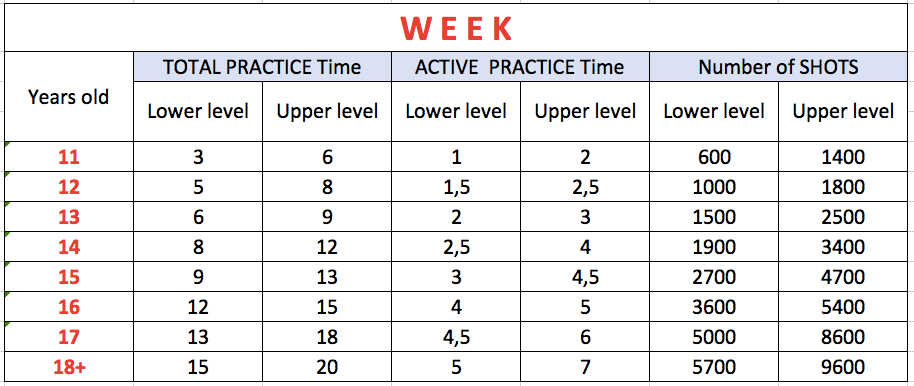
Now that we have defined some of the workload parameters that occur in ITF tennis players during matches, let us look at some data that determine the workload parameters during practice and matches. Based on ITF and LTA recommendations on the extent of tennis training, we have included in the table the recommended values for the above-mentioned parameters for individual age categories from 11 to 18 years. Since approaches to the development of junior tennis players vary greatly, we have also determined values for tennis players who, due to various factors (coach’s philosophy, court availability, financial capabilities, etc.), practise fewer (lower level) or more hours per week (upper level).
Three basic workload parameters
In the table, we defined three basic workload parameters, which can be monitored during practice:
- Total practice time: This is the time a player spends on court, from the first to the last shot in training. By setting the total time, we can properly plan training sessions and tournaments. During tournaments, the total amount of training must be lower, while in the preparation period it should be higher.
- Active practice time: This is the time when a player performs successive shots with breaks no longer than 7 seconds. Indirectly, it indicates the intensity of training and the frequency of shots in a specific time unit of training or match. Based on the active time, we can accurately determine the ratio between active time (work) and passive time (rest). Too little active time in training means the training load is not optimal and leads to stagnation, while too little passive time (rest) leads to overtraining.
- Total number of shots: This is an important indicator as it provides tennis-specific information on the frequency of shot execution, indicating whether a player has performed the appropriate number of shots in an individual training session and how the shots were distributed within the session. The total number of shots depends on the goals and content of the practice, the player’s technical competencies, focus, and fitness level.
Ratio between passive and active practice
Based on available studies, analyses of tennis matches, and measurements with the Matchbeep system conducted with our junior players, we concluded that the ratio between passive and active practice time is 2:1. In other words, active practice time represents 33% of total practice time. We used the values recommended by Cayer to determine the appropriate number of shots per minute. The recommended number of shots per minute when playing on the baseline is, for players aged 11–12 years, exactly the number of their age – so 11–12 shots; for ages 13–14 years, 13–14 shots; for the 15–16 years category, 15–18 shots; and for the 17–19 years group, 19–24 shots per minute.
Using the Matchbeep system, we monitored a group of 15-year-old tennis players in detail for one month and obtained interesting findings. First, some general information: male and female players aged 15 trained on average 21 days per month and completed 25 tennis training sessions. During this month, they spent 5 days at tournaments. In the observed month, they spent 36 hours on the tennis court. Each tennis practice or match lasted an average of 107 minutes.
Weekly values
The weekly values of the selected parameters were as follows: the average total practice time was 9.1 hours, active time was 2.8 hours, and the total number of shots was 4,095. The measurements showed that the total practice time was within certain recommended parameters. The active time was slightly lower than recommended, mainly due to competitions where there was more passive time. The number of shots performed each week was again within the recommended values.
Additionally, we found that the distribution of the duration of active phases was fairly stable. In most training sessions and matches, 70% of active phases involved players performing 1 to 4 shots (short), 20% involved 5–8 shots (medium), and 10% involved 9 shots or more (long). The distribution of point duration is consistent with O’Shannessy’s findings.
Examples of determining workload during matches and training are provided for individual age groups and different quality levels. It is known that different paths lead to success. Some coaches believe that a high number of shots indicates a great scope of practice, while others advocate higher intensity and quality of executed shots. Both approaches can be successful. It is important that each age and quality group has appropriate workload parameters. With individual long-term monitoring of workload, we can adequately increase it (to support the player’s growth and development) or, if necessary, reduce it (in cases of illness or injury) during training and tournaments.
The use of data analysis is entering the world of tennis in a significant way. Matchbeep is a simple and affordable tool that allows coaches, players, and their parents to monitor competitive and training parameters. With Matchbeep and its measurable, objective data, which can be monitored daily, weekly, or monthly, you can easily answer the question: “Is my junior tennis player (child) training correctly?”